
Helmet on his head, senior Hunter Coult attempts a double 45 on the rifle, a color guard skill that involves throwing a rifle into the air, spinning it twice at an angle and then catching it.
“It’s really scary … throwing a 45, and you’re like, ‘Oh, where’d it go?’” said Coult. “And then it boinks you on the head, and it hurts for three seconds and you’re like, ‘Alright, let’s try it again.’”
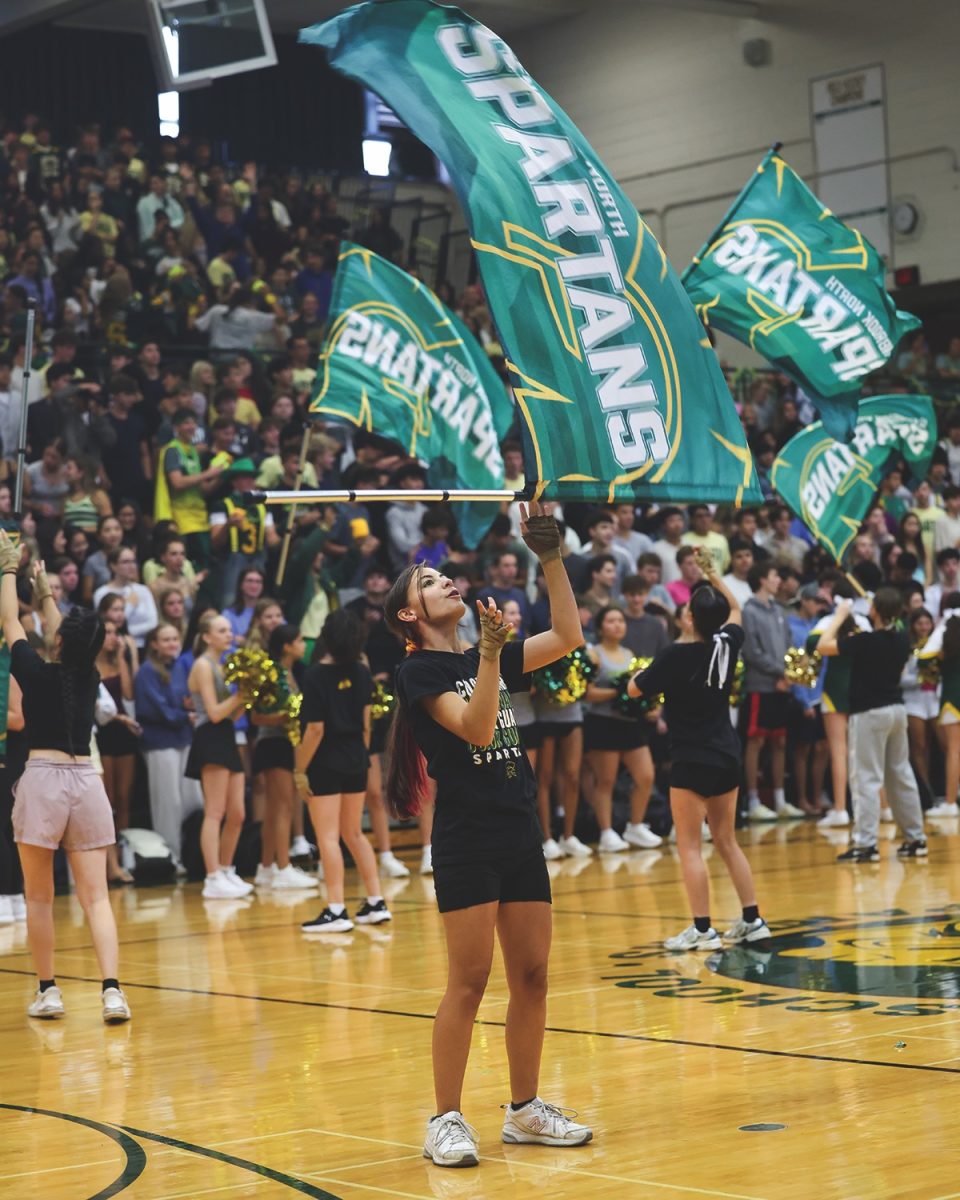
Combining musical interpretation and technique, color guard is a visual sport that incorporates dance and equipment usage, such as flags and rifles.
Color guard entails a lot of commitment because members do not know how to do color guard prior to entering Glenbrook North, color guard sponsor Brie Serdar said.
The color guard utilizes summer practices, during which members learn the technique from scratch, including how to dance and use the equipment.
Performing outdoors can be very difficult for color guard due to weather conditions, Serdar said.
“I teach my students how to throw into the wind,” said Serdar. “You have to throw [the equipment] whatever the way the wind is blowing so that it comes back at you, which is terrifying.”
The color guard meets and performs during two distinct seasons: fall and winter. The fall season concentrates on outdoor competitions with the marching band, while the winter season focuses on preparing to perform in thevariety show.
Color guard receives two different scores at competitions: a collective score with the marching band and an individual one based on general effect, which is how the visuals and equipment enhance the music and put the show together.
“You see crazy stuff at color guard competitions: props, things you would never think you would spin or do, and that’s really cool because there can always be surprises,” Serdar said.
According to Coult, it is fun to watch other color guards perform to see what their routines are and guess how long it might have taken to learn a move he has not yet learned.
Color guard intends to learn 12 to 15 routines every school year depending on its commitments, such as when the team learned a few more routines to join the band’s 2026 spring break trip to Spain and Portugal.
“We’re considered part of the band year-round, even though we only do the marching season,” Serdar said.
According to junior Addison Hodgin, the color guard and the band don’t always understand each other since their activities are different, but that barrier is easily broken due to their friendships.
At the end of the last joint color guard and band practice before a football game, it is tradition for someone to yell “last time” and for everyone to respond with “best time,”encouraging everybody to perform their best, Hodgin said.
According to Coult, when he had a big toss in a routine last year, he was able to think about his teammates’ words of encouragement as he took the field, calming his nerves.
“Before we go on the football field,I’m nervous and I’m shaking,” said Coult. “But then when I get out there, I’m like, ‘Game face, let’s go.’”