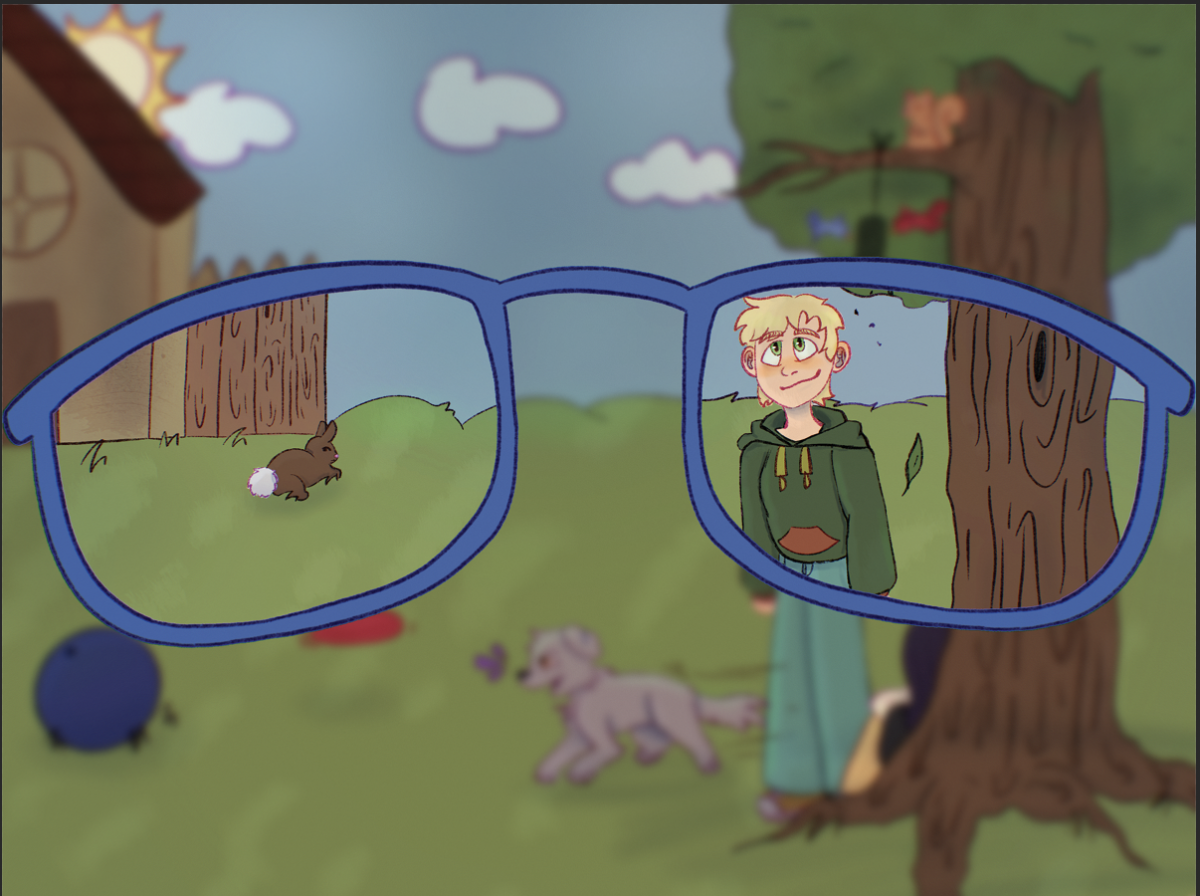
While sitting under the harsh white lights of the library, junior Michael Entchev wears blue light glasses that filter the light into a warmer and more comfortable tone.
“Initially, I thought [blue light glasses] were meant for screens, and I think that’s what my mom had intended as well, for back when I was heavily playing video games [and] my eyes were just at an all-time low,” Entchev said.
After sometimes waking with extremely blurry, tired eyes from little sleep and heavy Chromebook use, Entchev started wearing the glasses throughout the school day.
Overstimulating artificial light and very brightly lit screens cause visual strain, which may contribute to the progression of nearsightedness, said Dana Shannon, optometristat Clarendon Vision Advanced EyeCare.
Nearsightedness, also known as myopia, is a condition that causes blurry vision at a distance but clear vision up close. Myopia develops when the eyeball grows more elongated than normal
The majority of this progression starts during childhood and lasts up to the age of 18 or 19, when eye growth starts to stabilize, Shannon said.
In the last few decades, there has been a massive increase in the prevalence of myopia, primarily in children and teens, said Deborah Jones, clinical professor at the University of Waterloo School of Optometry and Vision Science.
“By 2050, it’s predicted that 50 percent of the world population will be myopic,” Jones said.
One cause of myopia is near work, or activities that require looking closely at objects, such as reading or using screens, Jones said.
“We don’t know for sure, but there’s basically a simple theory that if you spend most of your time doing something, your body will adapt to that,” said Jones. “So if you are spending a lot of time looking up close, then the visual system adapts to the least amount of effort for that working distance.”
According to Entchev, his non-school-related screen time is four to five hours day.
“I was so ashamed of myself because during the summer, my screen time was obviously a lot higher, but I think at one point there was a day where I was on my phone for a total of 10, 11 hours,” Entchev said.
According to Shannon, taking breaks from sustained near work can help prevent eye strain, headaches and myopia progression.
“There’s something called the 20-20-20 rule,” said Shannon. “You take a break every 20 minutes, stare at something 20 feet away for 20 seconds.”
Another preventive measure is to increase the distance at which we look at devices, with a suggested distance of at least 40 centimeters, Shannon said.
According to Mark Bullimore, adjunct professor at the University of Houston, there is also a strong association between spending time outdoors and a lessened likelihood of becoming myopic.
“The recommendation is [to go outside for] two hours a day,” Bullimore said.
According to Shannon, she has been seeing more cases of high myopia, defined as a prescription of minus six or greater.
“We’re born with only so much retinal tissue, and as that nearsightedness starts to progress, that tissue is stretching, and that tissue is becoming more weak and more susceptible to diseases,” said Shannon. “So diseases like glaucoma, retinal detachments, cataracts and macular degeneration [are more likely to occur].”
According to Jones, doctors try to slow myopia progression to avoid significant vision damage.
“We can’t turn the clock back,” said Jones. “If you’re already myopic, we can’t go backwards, but we can try and slow down the forward movement.”