
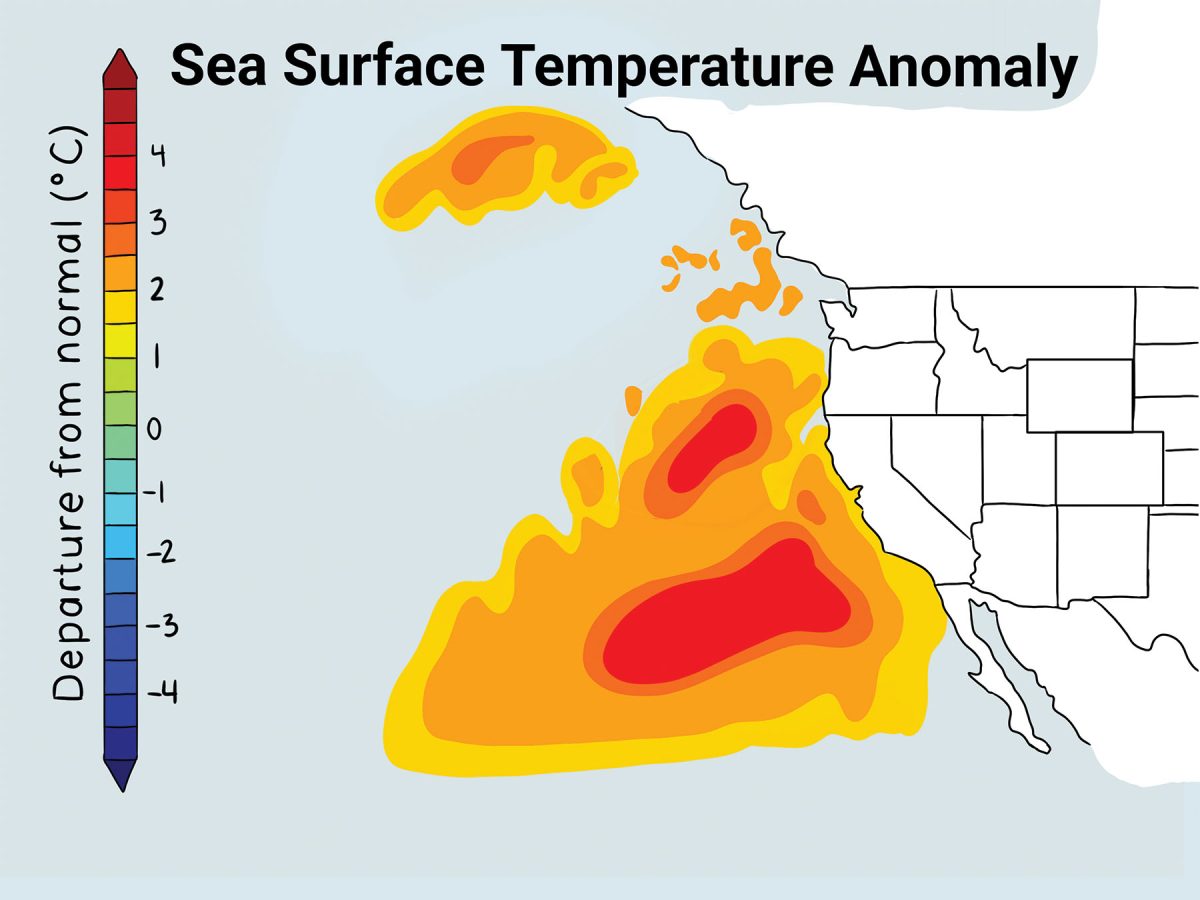
Chicago is no stranger to frigid winters, but a marine heat wave called “The Blob” may cause a drop in temperatures and an increase in snowfall in the Midwest.
“In August, [the National Oceanic and Atmospheric Administration] reported that overall sea surface temperatures, or ocean temperatures in the North Pacific region, shattered records,” said David Yeomans, meteorologist at CBS News Chicago. “[‘The Blob’] was over a really large area, quite far north toward Alaska. The average ocean surface temperature was 68 degrees Fahrenheit, which it had never been anywhere close to that before.”
“The Blob” is an area of above average ocean temperatures in the North Pacific that can create a bump northward in the jet stream, which is a narrow band of strong wind in the upper level of the atmosphere.
The jet stream reaches to the north above Alaska and then dips to the south across the Midwest, controlling where the warm and cold air masses are, Kevin Jeanes, meteorologist at NBC 5 Chicago, said.
“So then you have a better chance of [Chicago] getting more cold air that drops out from Canada,” Jeanes said.
“The Blob’s” conditions have picked up around January and February in the past, Jeanes said.
“The Blob” will also coincide with the return of La Niña, a cooling of ocean temperatures over the Equatorial Pacific that occurs every two to seven years.
“La Niña is kind of the same deal [as ‘The Blob’], but it’s the opposite,” said Yeomans. “That means the water down near the equator in the Pacific Ocean, farther south than ‘The Blob’ that we’re talking about, is colder than normal. Just like [how] ‘The Blob’ has consequences in the atmosphere, [La Niña] changes weather patterns.”
“Not only [is] ‘The Blob’ tilting our odds toward colder, snowier weather, but also this La Niña pattern tends to lead to colder, snowier conditions in Chicago,” Yeomans said.
According to Dr. Jeff Frame, teaching professor in the Department of Climate, Meteorology and Atmospheric Sciences at the University of Illinois Urbana-Champaign, La Niña’s effects tend to peak during the Northern Hemisphere winter and diminish in the spring.
According to Yeomans, the conditions that cause “The Blob” are tied to climate change.
“In a warming climate where humans continue to burn fossil fuels for transportation and for energy and for heat and for manufacturing, there will be more warm blob events,” Yeomans said.
The last three winters in Chicago have been below normal in terms of snowfall, Yeomans said.
“If we were to get a much snowier winter this winter, which is very possible, I think it might strike a lot of people around here as, ‘Wow, that was a worse winter than we’ve seen in a while,’” Yeomans said.