
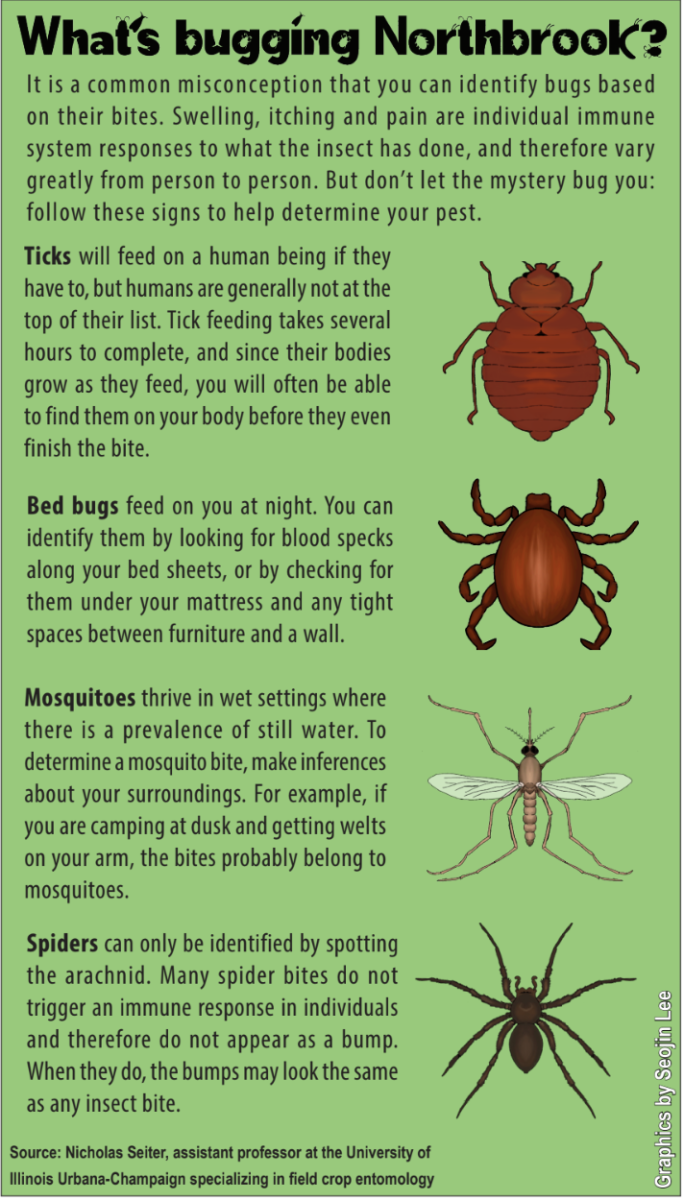
As Illinois experiences its second-wettest spring in 150 years, residents can expect more water-based insects this season.
“This year in particular is very wet,” said Jessica Wadleigh, collections assistant at the Field Museum. “So it’s going to be [insects] that are more prevalent in water-based climates. That unfortunately includes mosquitoes and other water-based flies that rely on water for their early stages of larval development.”
“You want to be more on the lookout for things like ticks and mosquitoes and make sure that you wear proper clothing when you go outside,” Wadleigh said.
According to Chris Stone, medical entomologist at the Illinois Natural History Survey at the University of Illinois Urbana-Champaign, wearing long pants and light colors is less attractive to bugs and makes it easier to spot insects on yourself.
Spotting and removing bugs such as ticks can help lower the risk of disease transmission.
There has been an early surge in American dog ticks this season because of the combination of a very wet spring and an unusually warm end of winter, Stone said.
“[Ticks] can be active pretty much any time of the year,” said Stone. “[But] the biggest peak will tend to be April, May, June, July, for ticks, and that’s when we see most of the Lyme disease cases.”
Close to 40 percent of adult blacklegged ticks carry the bacteria that cause Lyme disease, Stone said.
Lyme disease is a bacterial infection that commonly causes fever, fatigue and a distinct rash.
According to Wadleigh, people fear bugs and insects because they don’t understand them.
“There’s only four or five species of mosquitoes that can actually spread disease to us when there’s two to three thousand species of mosquitoes out there, and there’s many ticks that don’t bite humans either.”
According to junior Bridget Schwartzwald, “Some bugs are definitely scary, like if you see a really big spider, but it’s also a lack of education. There are certain ones, like the daddy longlegs, that are actually not even spiders.”
According to Joseph Spencer, principal insect behaviorist at the Illinois Natural History Survey, insects are under a lot of stress from our environment, and it is important not to automatically get rid of them.
“If you need to do something about them, [think], ‘Can you relocate them outside?’” said Spencer. “That’s one possibility. If you can tolerate the insects that live in your space, that’s good … If you don’t have to use a chemical on them, that’s good.”
Some insects cannot survive being relocated outside. Before removing them or using chemicals, it is important to identify the insect first.
There have been more regulations placed on pesticides, Wadleigh said.
“Last year, I noticed anecdotally and from some friends that asked me about it, that there was a higher prevalence of lightning bugs,” said Wadleigh. “People were saying that they haven’t seen them in 15 years, and part of it was that Cook County was spraying less for mosquitoes.”
“Insects are the base of everything ecologically,” said Wadleigh. “Without them, we would not exist. We need them for everything.”