
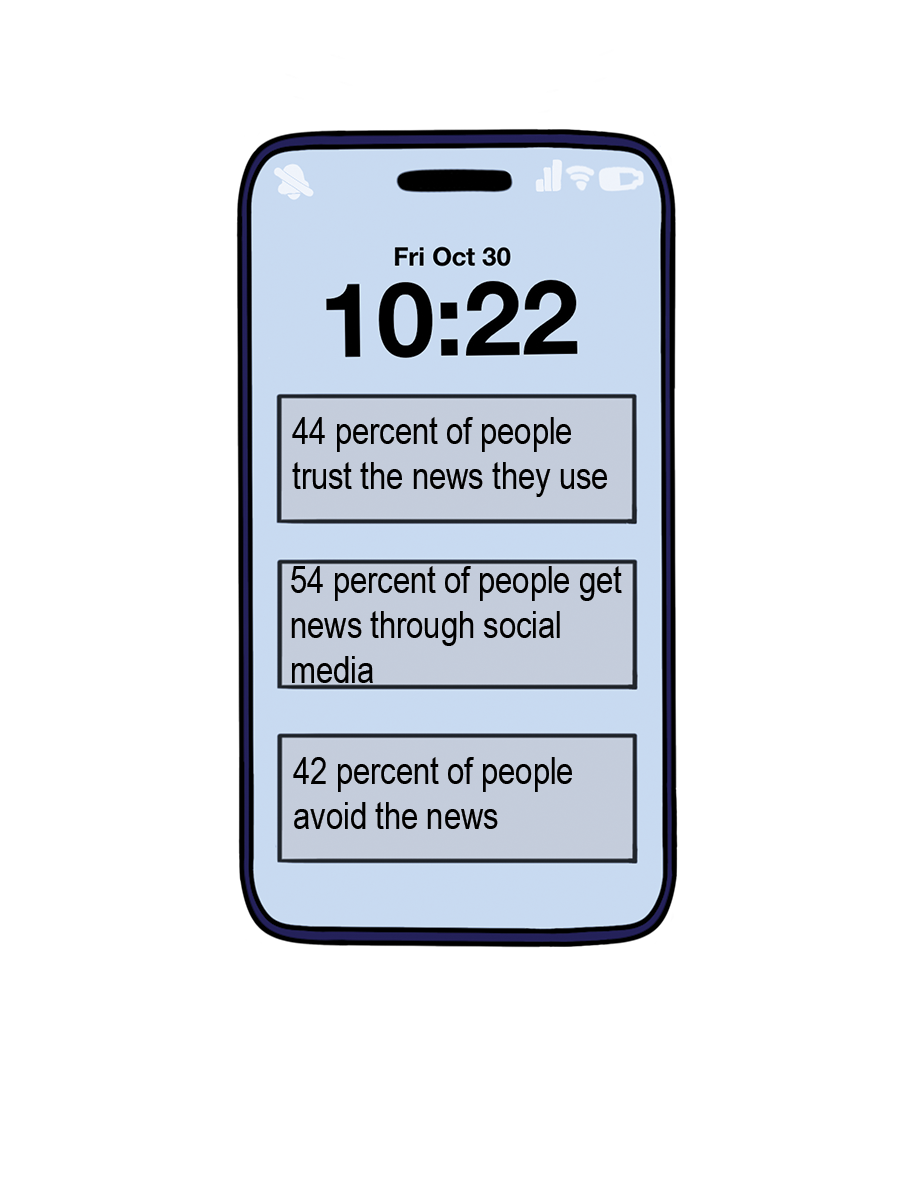
The number of people concerned about misinformation surrounding online news is at 62 percent.
“The whole point of [social media] is to be addictive and entertaining, and so in the moment, you don’t have the thought of where the information is coming from,” senior Lucas Kohler said.
According to Dr. Joy Jenkins, associate professor at the Missouri School of Journalism, younger generations are not going directly to news organizations’ websites or even to social media apps to get their news.
“They’re being exposed to [news] serendipitously through their social media consumption, and that’s been very different from previous generations,” Jenkins said.
Social media can expose young people to a wider range of perspectives while allowing them to seek out relevant information, find both communities and creators and participate in discussions through comments, Jenkins said.
According to Dr. Craig Robertson, postdoctoral research fellow at the Reuters Institute for the Study of Journalism, social media platforms struggle to moderate content given the scale of the internet and its unpredictability, which can enable the spread of misinformation.
According to Nic Newman, senior research associate at the Reuters Institute for Journalism, “Misinformation is not just things that are factually inaccurate but things that distort narratives or push people towards partisan views.”
Information from social media can be verified by going to a traditional news organization or search engines.
“I research a lot of the information I see on social media,” said Kohler. “If it’s something with foreign policy, there’s a magazine called Foreign Affairs, and they have a lot of expert professors in international relations.”
According to Melissa Zimdars, professor of Communication and Media at Merrimack College, approximately 70 percent of people aged 18 to 29 say they come across news influencers just by scrolling on social media.
“A news influencer is an individual creator who regularly posts about current events, politics or civic issues on social media and has a large following,” Zimdars said.
According to Matt Shearer, news influencer and social media reporter, it is easy to leave important information out of social media videos because the algorithm on Instagram does not push videos out to a broader audience if they are over three minutes long.
“If you see something that doesn’t quite sound right, tap on that person’s profile, see what their background is, check on the screen,” said Shearer. “Maybe do a little Googling yourself to see if there are other sources reporting the same thing, and don’t ever rely on the comment section.”
Social media users just believe comment sections rather than doing their own research, which has made comment sections under news stories a great source of misinformation, Shearer said.
“The best thing about the internet is that anyone can be a journalist,”said Shearer. “You don’t have to go to school for it. You can just do it. The worst thing about the internet is that anyone can be a journalist. You don’t have to have credibility.”
According to Kohler, people don’t usually pay attention to where information is coming from nor do they personally check someone’s account or bias on social media because it’s short-form content.
“In the past, we had independent journalism, and the idea that our news sources were supposed to be unbiased was much more emphasized,” said Kohler. “And all of those norms go away when we’re talking about social media.”