
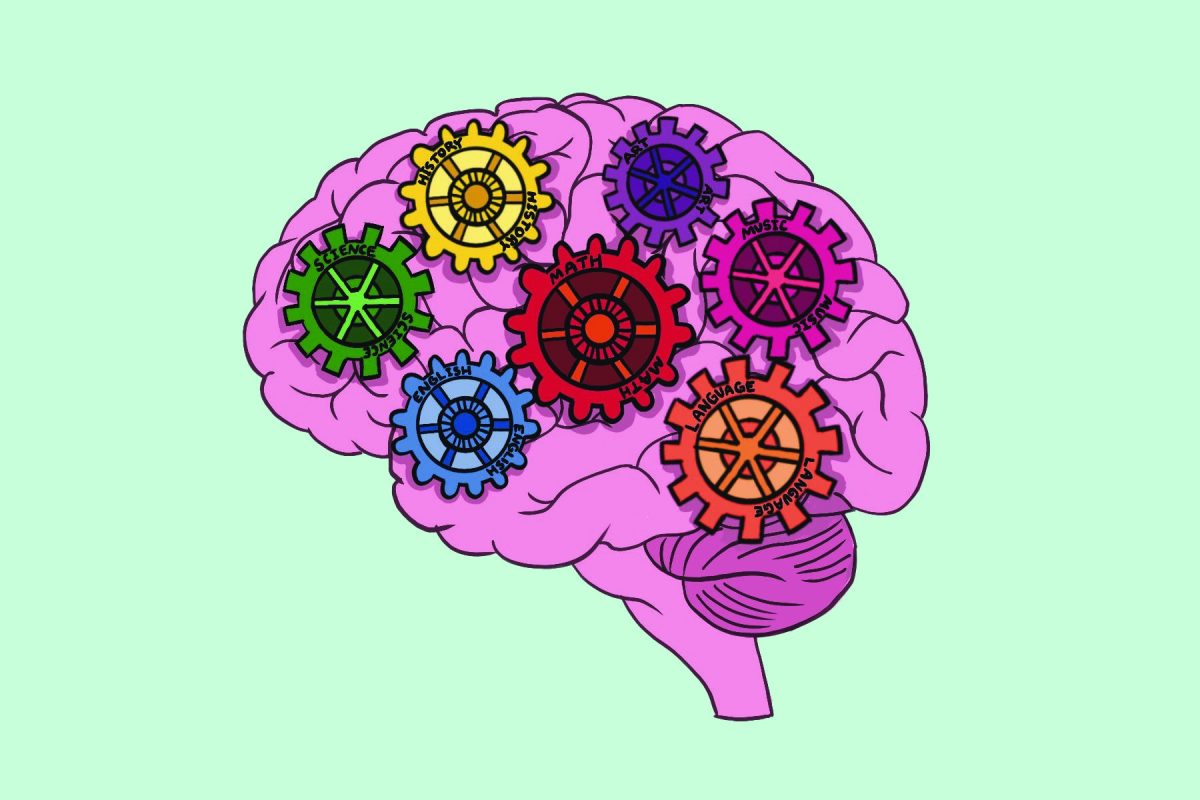
Many students believe they fall into one of two categories: “STEM people” or “humanities people.”
Bad at English? That must mean you’re a STEM person, right? Writing is not your thing. It’s okay. It’s not like people read or write outside of English class anyway. Once you graduate, you will never have to think about any school subject ever again, except for the one you specialize in.
Sounds logical, right? But real life rarely divides problems that neatly.
When students find a subject difficult, they may dismiss their struggle as a lack of natural ability. They often categorize themselves as being good at only certain areas, making excuses for their minimal participation and effort in classes in which they believe they cannot succeed.
“The thought, ‘Oh, I’m bad at this,’ has a couple different root causes,” said Allyson Even, academic designer at Imagine Learning, an educational technology company. “Are you bad at it, or are you not interested in it? Those are two different things.”
Rigid categorization of subjects makes little sense outside the classroom. Careers often considered one-sided are far more complex in reality.
“If you want to become a doctor but you’re not interested in learning about people’s ways of being, or people’s histories or people’s cultures, your impact as a doctor is going to have blind spots, and it’s going to have biases,” Even said.
Students should not let their inclination toward a singular subject prevent them from exploring a variety of class, even when doing so feels challenging. Critical thinking is limited without venturing into uncomfortable intellectual spaces.
Schools divide learning into subjects, but the abilities developed in classes rarely stay separate. STEM classes teach students complex problem solving, data analysis and innovation. Humanities classes teach communication, vocabulary and writing skills. When these skill sets overlap, students are better equipped to tackle complex problems.
Interdisciplinary learning means applying and integrating methods of knowledge across multiple subjects to gain a deeper understanding of sophisticated topics.
Embracing interdisciplinary learning starts with a shift in mindset. Students cannot control how subjects are divided in school, but they can change how they perceive and engage with them.
“I would just encourage kids to pursue their interests and then think about how that interest connects with multiple different disciplines,” Even said.
A disappointing grade or test result does not define a student, and neither should a single subject. With an interdisciplinary mindset, exploring beyond one’s perceived strengths becomes the expectation, not the exception.