
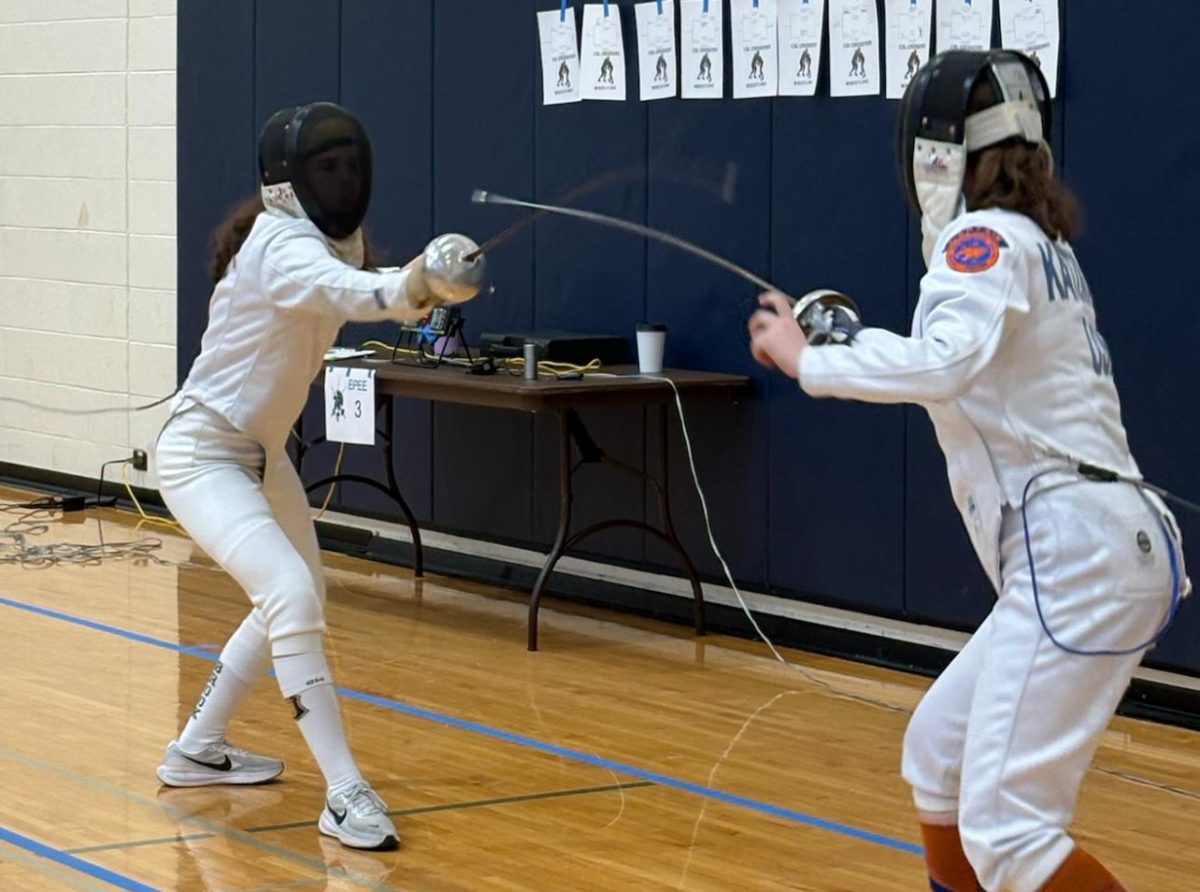
Three weeks before the 2025 Veteran Fencing World Championships in Bahrain, Edward Kaihatsu, head Glenbrook fencing coach, found out he had the opportunity to compete for the United States team.
“One of the guys had to drop out because of work, so they’re calling me and said, ‘Hey Ed, I know it’s kind of late notice, but do you want to go to the world championships?’” Kaihatsu said.
The world championships took place Nov. 12 to Nov. 20, 2025. Kaihatsu placed 18th in his division, the best finish of the American team.
Kaihatsu became the head coach of the Glenbrook fencing team in 2021 after a competitive college fencing career and coaching several NCAA Division 1 teams.
An epiphany in Kaihatsu’s junior year of high school led him to coaching, Kaihatsu said.
“I wanted to be a fencing coach,” said Kaihatsu. “Since junior year, that’s all I wanted to do, and I started trying to line up my life and path to be a fencing coach.”
The Glenbrook fencing team competes in three fencing styles, sabre, foil and épée, which are fought in bouts, the fencing term for matches. The girls team finished the season with a record of 10-3, and the boys team 9-3.
“You have sabre, which is the lightest [blade], because that’s the one you have to move the quickest with,” said sophomore Zara Dibra. “Then you have foil, which is the next lightest, because, again, speed. And then you have épée… That’s the heaviest blade. It’s got the biggest wrist protector and it’sprobably the slowest weapon.”
Points are awarded when a fencer’s blade hits their opponent above their waist for sabre, torso for foil and anywhere for épée, which is monitored by a sensor on the tip of the blades.
Fencing bouts are at least three minutes straight of bending your legs, having good posture and holding a heavy blade, Dibra said.
“I’m not going to call it a sword, by the way, we have to do 10 push ups every time we call it that,” Dibra said.
According to senior Mark Fine, Kaihatsu has seen it all.
“He’s fenced them all,” said Fine. “He can recognize what you may have in common with [other fencers] and [how] you may differ.”
Kaihatsu follows a college fencing mindset, said Fine.
According to Kaihatsu, coaching at Northwestern University taught him to consider his players’ attributes and abilities, rather than think about what he would do in a situation.
Practice is for experimenting with different strategies, Kaihatsu said.
“For me, a successful bout is when they make changes [to how they fence normally],” said Kaihatsu. “I don’t care who wins or loses in practice, it’s practice.”
According to Fine, he strives to be like Kaihastu because he is the most competitive fencer among the three coaches.
“I feel like I can carry that competitive mindset to absolutely everything I do, in terms of doing well in school, working, just my whole lifestyle,” said Fine. “Fencing revolves around discipline and putting your mind to it, staying focused, staying confident.”