
Female athletes face a two to three times higher rate of ACL tears than males. One in 29 females will rupture their ACL as opposed to one in 50 males.
“There is a higher odds ratio of eight [to one] for female athletes tearing their ACL [compared to males],” said Dr. Hayden Baker, sports medicine orthopedic surgeon at Skokie Endeavor Health Orthopedic and Spine Institute.
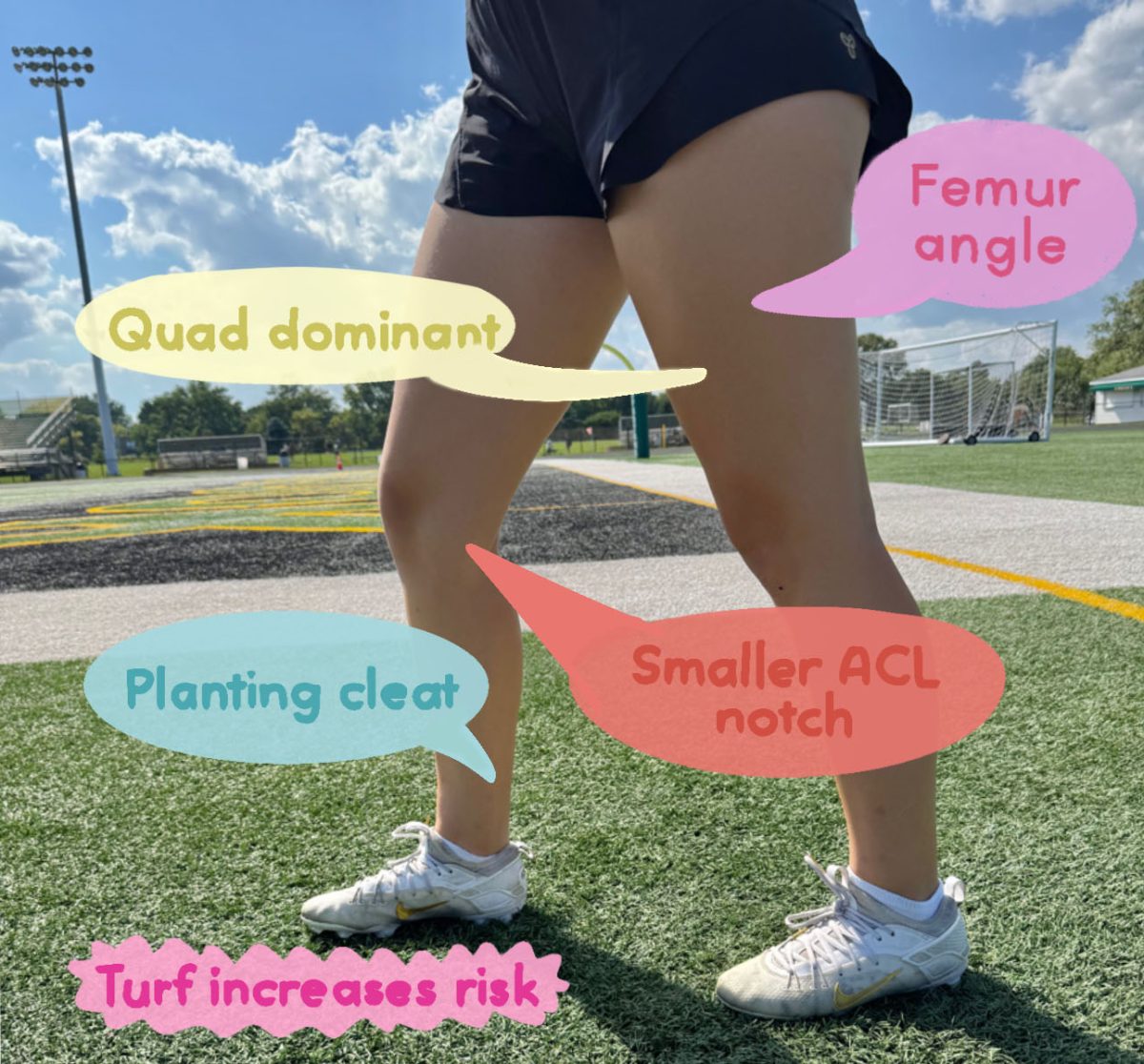
The top factor as to why women are more prone to ACL injuries is basic anatomy and what is called the Q-angle, said Paul Kim, physical therapist and clinic manager at the Deerfield Athletico.
“So because women generally have wider hips than men, the femur typically will angle in a little bit more when it comes down from the hip down to the knee [creating a larger Q-angle],” Kim said.
According to Baker, there is a relative muscle imbalance between the hamstrings and quadriceps in women as their quads are stronger while for men those muscles are more even, increasing the risk of ACL tears for women.
The notch in the knee that holds the ACL can be smaller in females and causes the ACL to rub against the bone, which increases the risk of an ACL tear, Baker said.
According to Kim, the amount of games being played, fatigue, hyperspecialization in a singular sport and the type of terrain being played on are also variables as to why an athlete can tear their ACL.
“And then there’s just the presence of cleats where your feet can kind of dig in,” said Kim. “That’s another reason why ACL ruptures do occur. If you plant [into] the ground and you kind of add a twist, the knee is at the biggest risk in a position like that.”
Tearing the ACL can happen through contact or no contact.
A contact ACL tear is what people see on TV with football when a player’s knee buckles and the player holds their knee, saying they felt a pop after running and getting tackled from outside of their knee, Kim said.
“And then the second way you typically see them, they’re called non-contact injuries,” said Kim. “ … It’s an injury where you’re trying to pivot really fast or land on a single leg and just from the weight of the body, the ACL will usually pop or rupture just under stress.”
The recovery process is usually nine to 12 months.
“You can kind of start walking a little bit better right around that three-month mark and then about the four-month mark, you start running, and building that up, and then from there, it’s really just building your strength and your trust in your body that it’s gonna hold,” head athletic trainer Ryan Moran said.
According to Baker, a way to help prevent ACL tears is a protocol called FIFA 11+.
“It’s 11 different exercises that you can do before playing soccer, or whatever sport you play, that have been shown to decrease the risk of ACL injury,” Baker said.
According to Kim, weightlifting certainly helps prevent ACL tears.
“Injury prevention, I think, is always at the forefront [of combating ACL tears],” Kim said.