
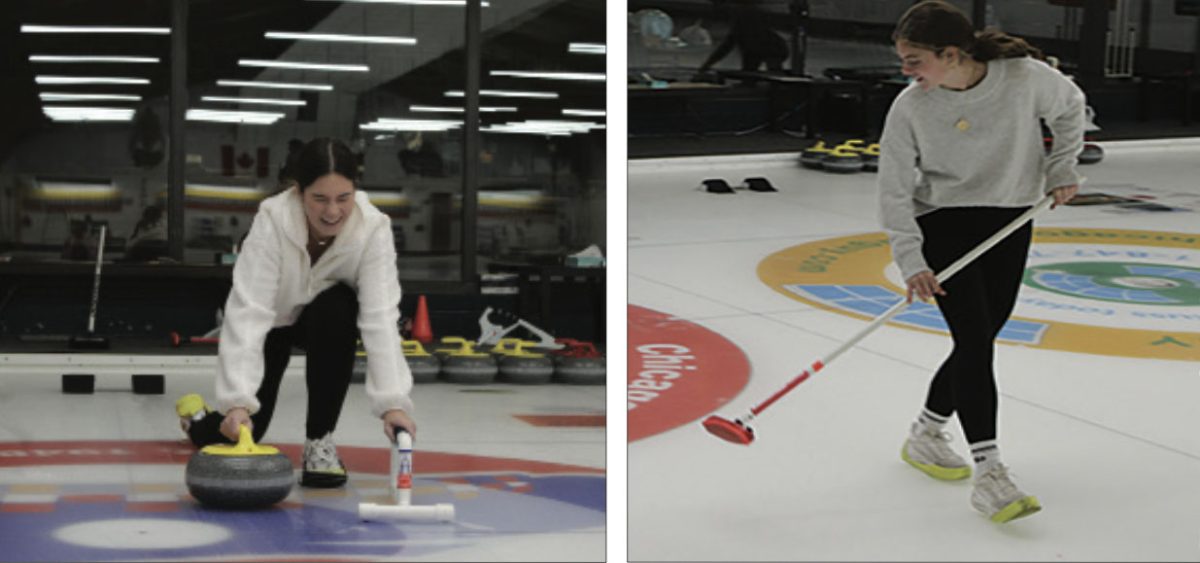
With winter approaching, Torch editors Natalie Mahoneyand Lauren McClamroch decided to try a lesser-known sport, curling. The sport involves sliding a rock across ice toward a target. Each team has four members, one who releases the rock, two who sweep, and a “skip” who communicates with other players and develops team strategy. As total beginners, Mahoney and McClamroch took a lesson with Karrie Gottschild, a member and volunteer at the Chicago Curling Club. Below is their experience.
Arrival:
When we walked into the club, our nerves were eased by the crackling fireplace and people greeting us kindly as they casually arrived after work. Gottschild gave each of us a slider, a device that gets attached to the bottom of one shoe, and grippers, which are rubber covers for the bottom of our gym shoes. Sliders allow a curler to glide across the ice whereas grippers prevent slipping while sweeping.
Off the ice:
Before getting on the ice, Gottschild walked us through the proper squatting and lunge form and how to push off from the hack. The hack is a starting block, where the non-sliding foot is placed. It was surprisingly hard to balance and engage our core in the lunge position, which made us nervous to step onto the ice.
Baby steps:
The first thing we did in the rink was practice walking across the ice with the slider on our non-dominant foot. Once we felt comfortable moving around, we tried pushing off from the hack without the rock. Even though we naturally wanted to look down to focus on balancing, Gottschild reminded us to keep our eyes on the target.
The rock:
We then practiced the release, which combined pushing off the hack with sliding the rock, a heavy stone with a handle on top. Gottschild first instructed us to pass the rock back and forth, then told us to think about the release like extending our hand for a handshake, rather than pushing. We learned two grips by angling the handle of the rock at 10 o’clock or 2 o’clock. The 10 o’clock grip came more naturally to us, but we had to practice until we could do both.
Sweeping:
Although we were eager to start aiming for the target, we still had to master sweeping. Sweeping involves two team members using brooms with flat bottoms to guide the rock to the target. Gottschild emphasized the importance of being forceful, which we found difficult because it was hard to keep up with the speed of the rock while applying enough pressure to the ice.
When we swept for the first time, Gottschild shocked us when she abruptly yelled “Yes! Yes!” and we scrambled to begin sweeping. We were confused again when Gottschild said “Up! Up!” but realized she wanted us to pick up our brooms. We struggled to react quickly to her cues.
Reaching the target:
To finish our session, we put together sweeping and the release from the hack. Having practiced each component individually, we were more confident than in the beginning. The first few times, the rock did not make it to the target. We had to try multiple times to find a balance between the power from the release and the effort of the sweeper. Gottschild told us to think about the power coming from our legs rather than pushing the rock, which helped us ultimately land five out of eight rocks on the target.
Curling to a conclusion:
While some skills felt unnatural at first, like balancing in a lunge and releasing the rock, we think that curling is a very beginner friendly sport. With a few repetitions of each movement, we were ultimately successful in picking up the skills of curling. We left feeling confident in our curling abilities and enjoyed our time on the ice.