
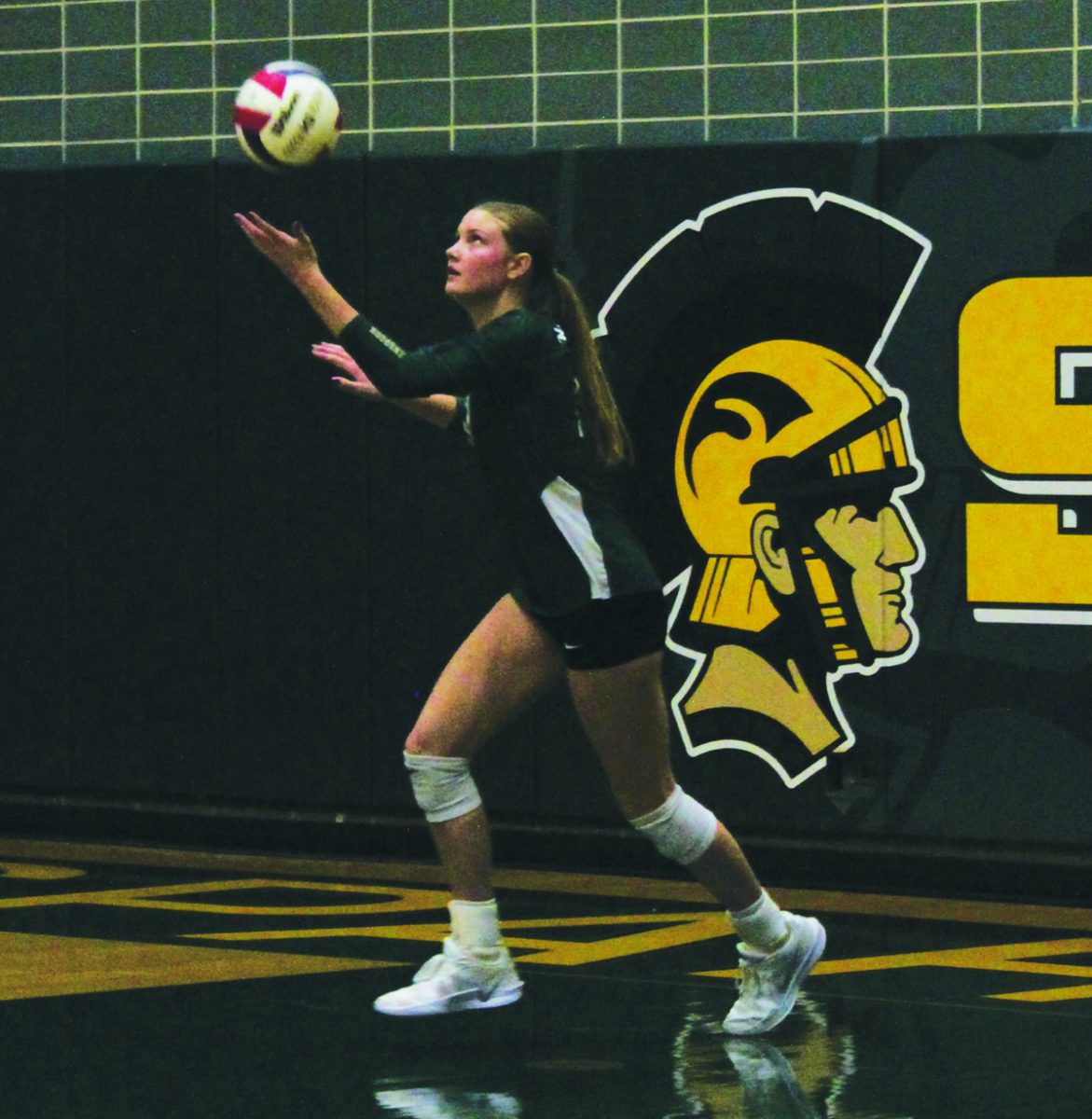
When senior Claire Dillon prepares to serve, she bounces the volleyball three times in two different ways and spins it across her hand.
“I started doing [the spin] because my mom told me when she used to play volleyball she spun the ball before she served,” said Dillon. “When I was younger, I couldn’t figure out how to do it, and I was really upset because I wanted to be like my mom. But now that I figured it out, I do it before every single serve.”
“Once I started it, I just kept it because I realized how it’s the perfect length right before my serve,” said Dillon. “So I have time to actually take a step back and breathe before I serve.”
According to Dr. Marc Cormier, director of performance psychology for the University of Kentucky Athletics, rituals are intentional, repeatable behaviors athletes use to create a sense of stability in an inherently uncertain environment.
“There’s a lot of pressure, and we generally lack control over so many of the factors that are involved in a competition,” said Cormier. “So rituals can actually help us restore a sense of agency and direction.”
According to Christina Mondragón Schrader, licensed clinical professional counselor and certified mental performance consultant, an athlete engages in a ritual to control the controllable, create consistency and to maintain a confident mindset.
“The idea is actually to think less and to trust your skill, to trust the training that you had done,” said Schrader. “And so [a ritual] helps promote that. It helps prime the mind and the body for the game or for the task at hand.”
There is a difference between a ritual and a superstition.
“If it’s a ritual, you’re in the moment,” said Kate Schneider, co-owner of Pure Health Center, licensed clinical professional counselor and sports mindset coach. “A superstition, you’re ahead of yourself … That’s why [a ritual is] so beneficial to an athlete in their performance, because the whole goal is to get an athlete to perform in the moment, and superstitions are more future based.”
Schneider says that rituals can reduce sports anxiety and injury, increase performance flow and enjoyment, and overall calm the mind and body.
Having a structured routine with breathing, stating a mantra, visualizing prior to competing and tapping into your senses can lead to better performance, Schneider said.
According to Dillon, there have been a couple times where she’s dropped the ball or spun it in a different way.
“It doesn’t necessarily mean that I will miss my serve,” said Dillon. “Sometimes it does, but [serving afterward] definitely does not feel right.”
Having the rhythm down makes her feel calmer going into her serve, Dillon said.
“Find something that’s easy, something that you can do every time,” said Dillon. “Don’t do anything crazy. Make sure that it’s achievable and something that will help you reset your focus.”